


Aligner therapy at ZAK
With transparent aligners, mild to moderate tooth misalignments can be corrected discreetly. The trays are removable, almost invisible, and easy to integrate into everyday life.
At ZAK, we do not view aligner therapy solely as an aesthetic measure. Before every treatment, we assess tooth alignment, bite, gums, periodontal support structures, existing fillings, crowns, dental restorations, and overall oral health. After all, tooth correction should not only look better, but also be functionally sound and planned for long-term stability.
Aligners can be a sensible option for crowding, small gaps, minor rotations, or aesthetic corrections. Prior to veneers, dental restorations, or other aesthetic treatments, correcting tooth alignment beforehand can also help preserve healthy tooth structure and prepare a more harmonious result.
When are aligners suitable?
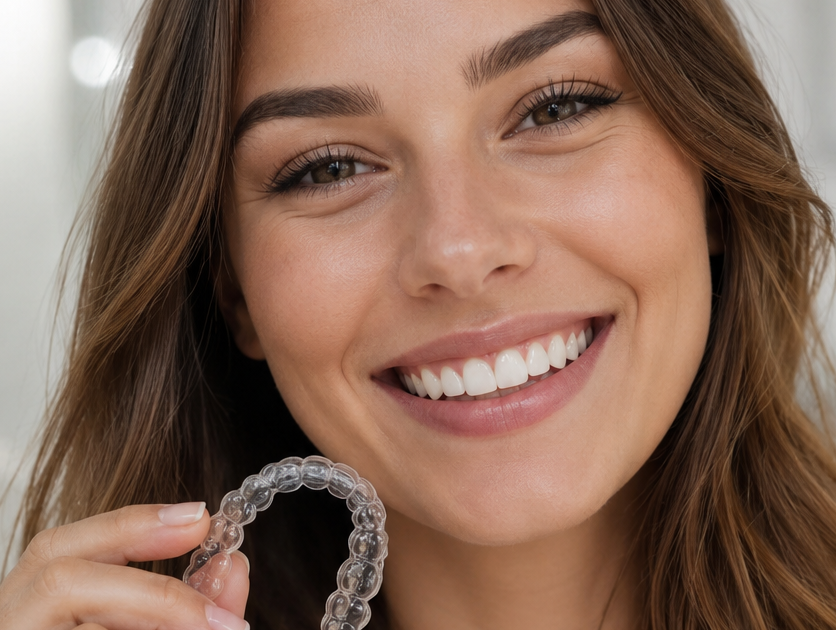
Aligners are particularly suitable for patients who would like to improve their tooth alignment discreetly without wearing fixed braces. The transparent trays move the teeth step by step in the planned direction.
Crowding and minor tooth shifts
If teeth are crowded, rotated, or have shifted slightly, aligners can help improve alignment. Especially in the visible front-tooth area, many patients want an inconspicuous correction.
Gaps between teeth
Depending on the initial situation, smaller gaps can also be treated with aligners. It is important to understand the cause of the gaps and to check whether the bite, tooth shape, and gum situation are compatible with the planned movement.
Preparation before aesthetic treatments
Sometimes aligner therapy is the better first step before veneers, bleaching, or dental restorations are planned. If tooth alignment is improved, subsequent work can often be more conservative and look more natural.
Taking function and bite into account
Aligners should not only change appearance. In every plan, we also pay attention to the bite, contact points, chewing load, and gums. An aesthetic tooth correction must be functionally sound.
Not every misalignment is suitable
Not every tooth misalignment can be treated sensibly with aligners. That is why a thorough examination and consultation always take place before starting. If another orthodontic or dental solution is more suitable, we will discuss this openly.
Aligner therapy at ZAK means discreet tooth correction, careful planning, and a result that brings aesthetics, function, and oral health together.
Digital planning and a clear treatment process
At ZAK, aligner therapy does not start with the tray, but with a thorough examination and digital planning. Before starting, we assess tooth alignment, bite, gums, periodontal support structures, existing fillings, crowns, dental restorations, and overall oral health.
Digital impressions with an intraoral scan
Your dental situation is captured digitally with an intraoral scanner. This creates a precise dataset of the teeth that can be used as the basis for further planning.
The benefit for patients: planning can be prepared without conventional impression material, and the initial situation can be presented and explained more clearly in digital form.
Plan the treatment goal realistically
Based on the digital data, we plan which tooth movements are realistically achievable. This is not only about straight teeth, but also about the bite, contact points, dental arch shape, gum situation, and long-term stability.
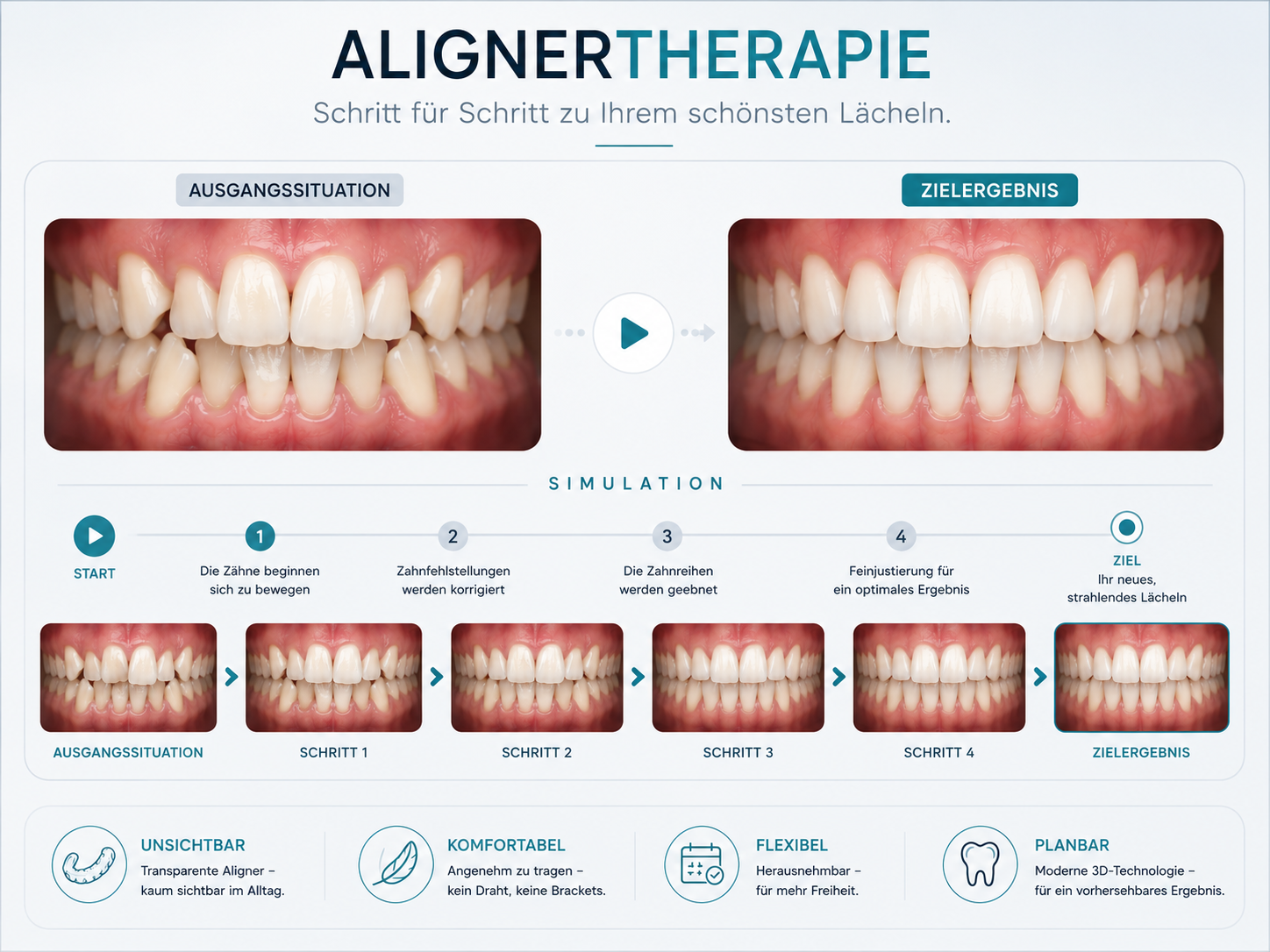
A realistic assessment is important. A digital simulation can show the intended outcome, but it does not replace dental evaluation and monitoring during treatment.
A series of trays according to the treatment plan
The aligners are worn in a planned sequence. Each tray moves the teeth step by step toward the planned position.
For the treatment to work, the aligners must be worn consistently. They are removed for eating, drinking anything other than water, and for oral hygiene.
Attachments and minor corrections
Depending on tooth alignment, small tooth-coloured attachments on the teeth may be necessary. They help to control certain tooth movements more effectively.
In some cases, minor interproximal reduction between the teeth can also be useful to create space. Whether this is necessary will be explained in advance and planned individually.
Regular check-ups
During treatment, we check regularly whether tooth movements are progressing as planned. We assess the fit of the trays, the bite, the gums, oral hygiene, and overall progress.
If adjustments are necessary, they can be incorporated into the ongoing plan. Aligner therapy is therefore not a purely technical process, but a dentist-supervised treatment.
Stabilisation after treatment
After the active tooth movement is completed, stabilisation is important. Teeth can shift again if the result is not maintained.
That is why we discuss at the end which form of retention is appropriate—for example, removable retention trays or other suitable measures.
Aligners at ZAK at a glance
- Transparent trays
- Digital planning
- Dental monitoring
- For mild to moderate misalignments
- Aesthetics and function considered together
- Removable for everyday life
- Consistent wear is important
- Regular progress check-ups
- Retention after treatment
- Part of an overall aesthetic concept
Limitations and patient compliance
For mild to moderate tooth misalignments, aligner therapy can be a good way to improve alignment discreetly. However, not every misalignment is suitable for aligners. That is why we carefully assess before starting whether this treatment is medically appropriate for your situation.
Patient compliance is important for treatment success. The trays must be worn as discussed so that the planned tooth movements can be achieved. The aligners are removed for eating, drinking anything other than water, and for oral hygiene.
During treatment, we check regularly that the trays fit well, tooth movement is progressing as planned, and gums and oral hygiene remain stable. If adjustments are necessary, we will discuss them with you.
Not only after aligner therapy
Memotain® can also be a sensible option if a patient was previously treated in an orthodontic practice. If a fixed retainer is planned there or an existing wire retainer is to be replaced, we can assess whether a digitally manufactured Memotain® retainer is a suitable solution.
We assess tooth alignment, bite, space conditions, gums, oral hygiene, and existing retainers or bonding sites. Only then do we decide whether Memotain® can be used appropriately.
Regular monitoring remains important
Even a high-quality fixed retainer must be checked regularly. What matters is stable retention, intact bonding sites, unchanged tooth alignment, and healthy gums.
Stabilisation with a Memotain® retainer
After orthodontic treatment, stabilising the result is particularly important. Teeth generally tend to shift again. That is why so-called retention is an integral part of treatment—not only after aligner therapy, but also after conventional orthodontic treatment.
At ZAK, we do not only provide our own aligner patients with retainers. We also often see patients who have completed orthodontic treatment at another practice and now need a fixed retainer, would like to replace an existing retainer, or are looking for a higher-quality retention solution.
What is a Memotain® retainer?
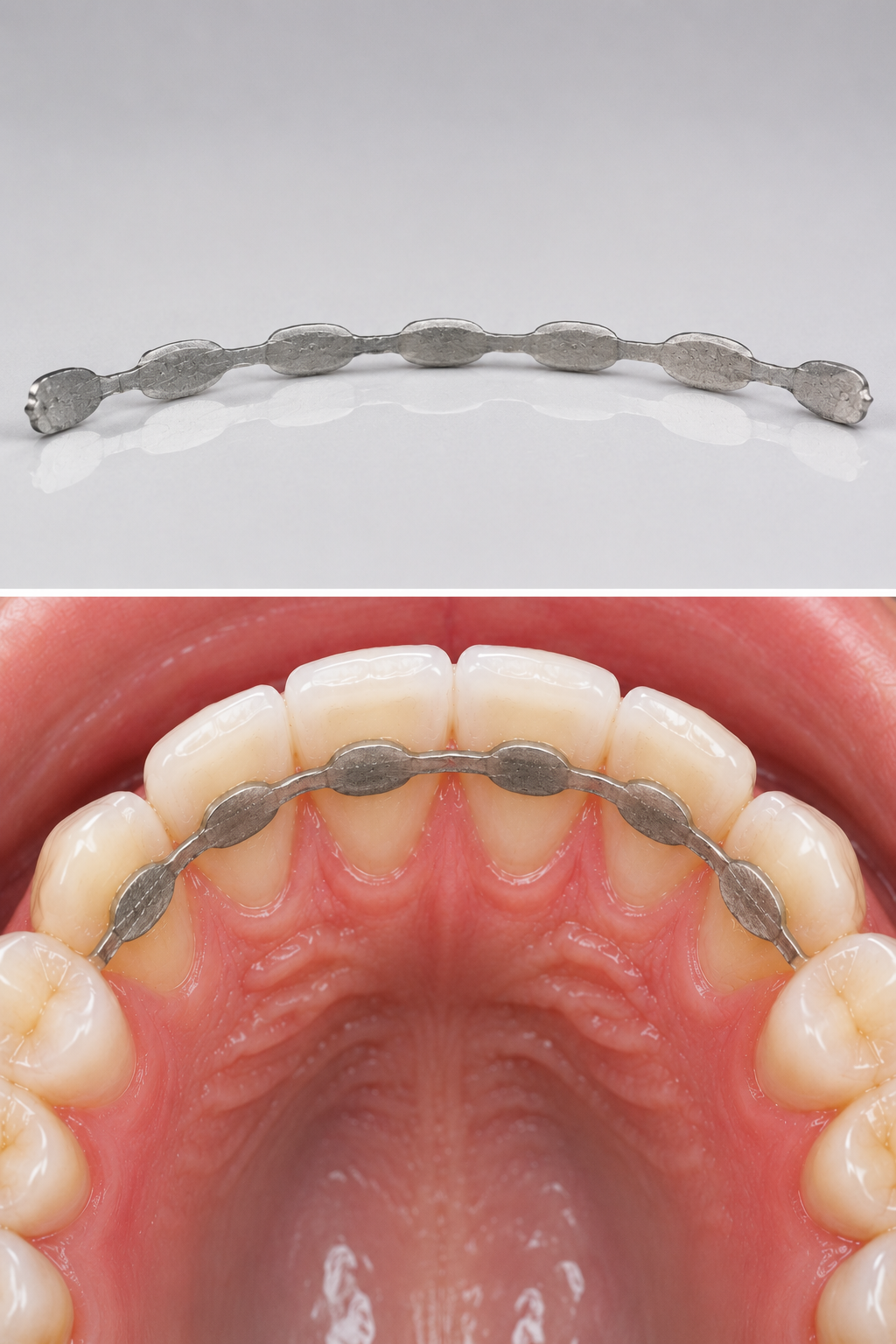
The Memotain® retainer is a custom, digitally manufactured fixed retainer for the inner surfaces of the front teeth. It is planned on the basis of digital data and CAD/CAM-manufactured from nickel-titanium, also known as Nitinol.
Unlike classic hand-bent wire retainers, Memotain® is not shaped freely, but digitally designed and manufactured to fit the individual tooth shape precisely. This allows the retainer to sit very accurately on the inner surfaces of the teeth and be bonded discreetly.
Digital scan instead of a conventional impression
The process begins with a precise digital scan of the dental situation. Based on this, the retainer is planned and manufactured. Digital planning enables very accurate adaptation to tooth shape, dental arch, and bonding surfaces.
This is particularly important because a retainer is worn long term. It should not be bothersome, irritate the tongue as little as possible, allow cleaning, and reliably stabilise tooth alignment.
Benefits of the Memotain® system
A key advantage is precise CAD/CAM manufacturing. The retainer is made individually for the specific tooth alignment and does not need to be bent by hand in the traditional way. This allows the fit, seating, and position to be planned very precisely.
Thanks to its slim design, the retainer is discreet in everyday life and usually comfortable to wear. It sits on the inner surfaces of the teeth and is not visible from the outside.
The nickel-titanium material is flexible and dimensionally stable. This makes it particularly suitable for long-term stabilisation of the front teeth when the situation is appropriate.
Cleanability also plays an important role. A precisely fitting, slim retainer can make at-home oral care easier because there are fewer obstructive wire sections or unnecessary bends.
Aligner consultation at ZAK
Would you like to know whether aligner therapy is suitable for you? We assess tooth alignment, bite, gums, and oral health, and explain clearly which options are realistic.